See It In Action
Watch a quick demonstration of the symbolic math engine handling a complex derivative (more demos: integral and simplification below):
How to Use the Interface
The web interface provides an intuitive workflow for symbolic computation:

1. Input Bar
Type a mathematical formula using standard notation and press Enter to parse it into the expression tree.
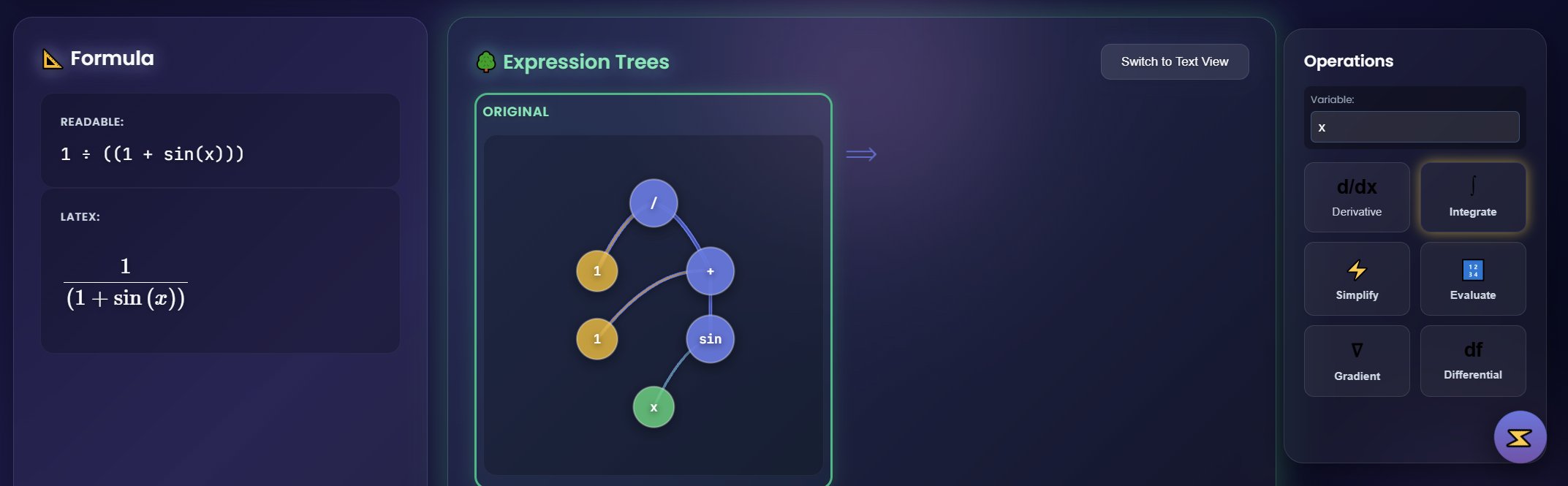
2. Tree View & Operations
Once entered, the original formula appears on the left as a tree structure. Choose operations from the right sidebar to proceed: differentiate, integrate, simplify, or evaluate.
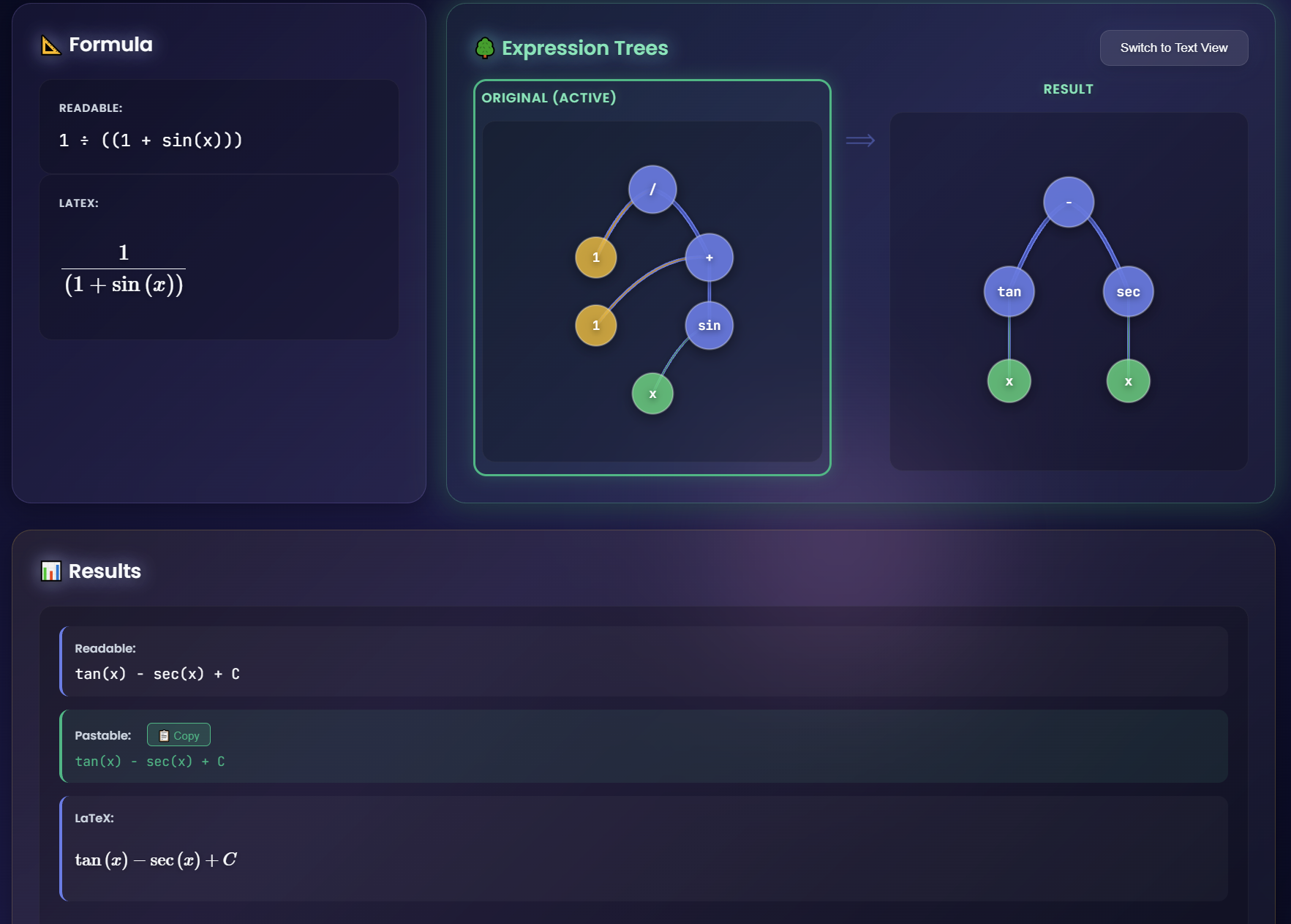
3. Result Display
The result is shown as a tree structure, written out in raw infix form, and beautifully rendered in LaTeX notation.
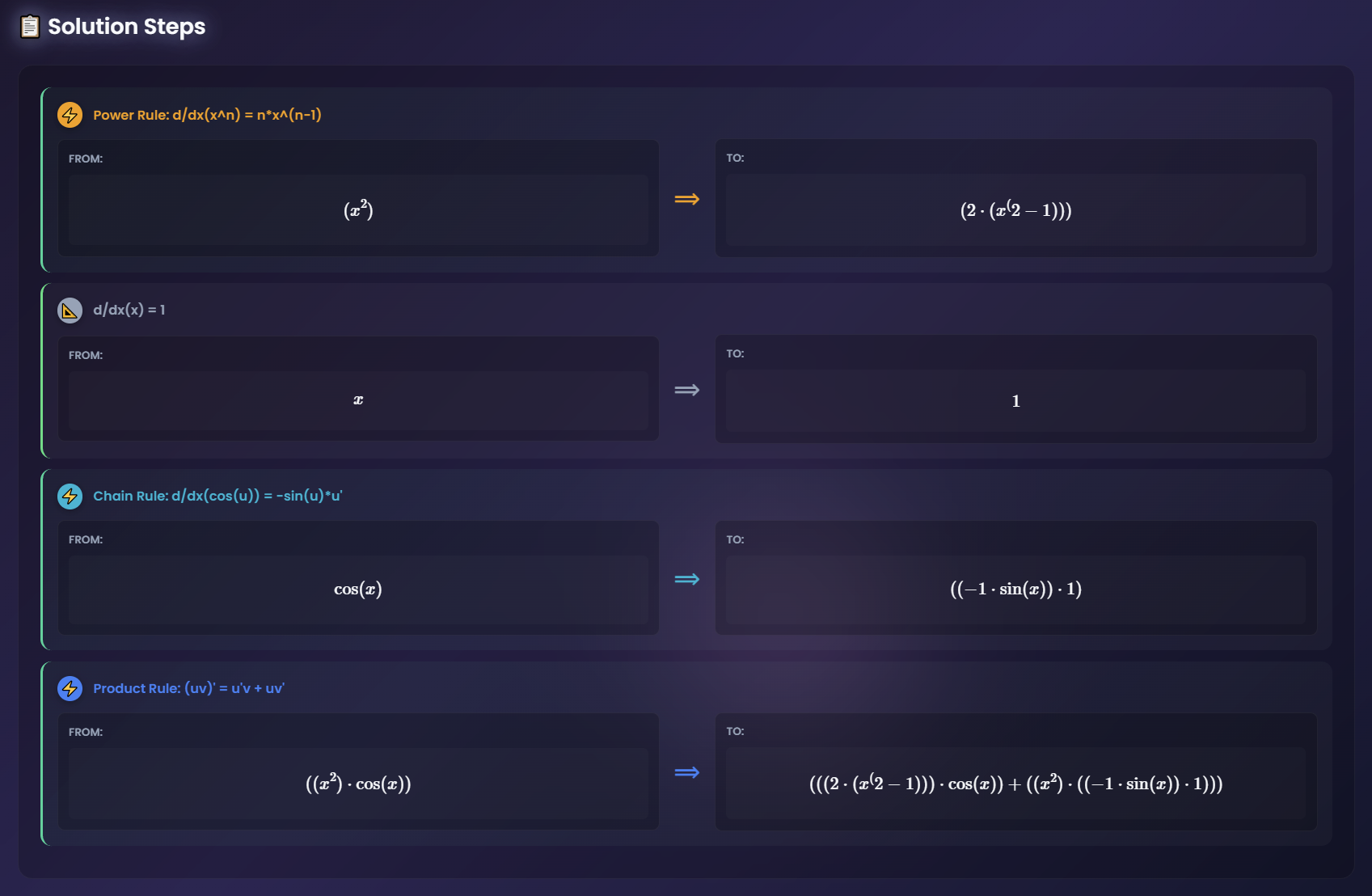
4. Step-by-Step View
Expand the steps section below to see every transformation applied during the computation, perfect for learning and debugging.
What It Can Do
Tree-Based Architecture
Expressions are represented as binary trees, where operators form internal nodes and operands form leaves. This elegant structure enables recursive algorithms for all operations.
Symbolic Differentiation
Complete implementation of calculus rules: product rule, quotient rule, chain rule, and derivatives of all elementary functions. Handles arbitrary compositions.
Heuristic Integration
Pattern-matching integration with algebraic simplification, by-parts detection, substitution, and partial fractions—covering common integral forms without a full decision procedure.
Smart Simplification
Iterative simplification engine with algebraic rules, constant folding, identity elimination, and experimental expansion strategies.
System Architecture
Expression Tree Data Structure
At the core of the system is the ExpressionNode class, implementing a binary tree where:
- Leaf nodes contain constants or variables
- Internal nodes contain operators (+, -, ×, ÷, ^, sin, cos, ln, etc.)
- Each node maintains pointers to left child, right child, and parent
- Unary operators (sin, cos, ln) use only the right child
class ExpressionNode
  attr_accessor :isleaf, :data, :left, :right, :parent, :type

  def initialize(is_leaf, value)
    @isleaf = is_leaf
    @data = value.is_a?(Numeric) ? value : value.clone
    @left = nil
    @right = nil
    @parent = nil
    @type = nil
  end

  # Deep clone of node and its subtree
  def deep_clone
    new_node = ExpressionNode.new(@isleaf, @data)
    new_node.type = @type

    if @left
      new_node.left = @left.deep_clone
      new_node.left.parent = new_node
    end

    if @right
      new_node.right = @right.deep_clone
      new_node.right.parent = new_node
    end

    new_node
  end

  # Check if subtree is constant with respect to a variable
  def constant_wrt?(variable)
    return false unless self

    if @isleaf
      return @data != variable
    end

    left_const = @left ? @left.constant_wrt?(variable) : true
    right_const = @right ? @right.constant_wrt?(variable) : true

    return left_const && right_const
  end
end
The deep_clone method is crucial for derivative and integration operations, as it allows us to create independent copies of subtrees without modifying the original expression. The constant_wrt? method recursively checks if a subtree depends on a given variable, enabling optimization of integration and simplification routines.
Tree Visualization System
One of the most elegant parts of the codebase is the tree visualizer, which renders expression trees with beautiful Unicode formatting:
def visualize_node(node, prefix, output, show_values, branch_type = "ROOT")
  return unless node

  # Node visualization with clear branch indicators
  if branch_type == "ROOT"
    output.print "  🌲 ROOT: "
  else
    output.print prefix
    if branch_type == "LEFT"
      output.print "├─[L]─ "
    else
      output.print "└─[R]─ "
    end
  end

  # Node content with styling
  if node.isleaf
    case node.data
    when Numeric
      output.print "【#{format_number(node.data)}】"
    when String
      if @variables.key?(node.data)
        value_str = show_values && @variables[node.data] ? "=#{@variables[node.data]}" : ""
        output.print "<#{node.data}#{value_str}>"
      else
        output.print "【#{node.data}】"
      end
    end
  else
    output.print "⟨#{node.data}⟩"
  end
  output.puts

  # Recursively display children with proper indentation
  if node.left || node.right
    new_prefix = branch_type == "ROOT" ? "  " :
                 branch_type == "LEFT" ? prefix + "│      " :
                                        prefix + "       "

    visualize_node(node.left, new_prefix, output, show_values, "LEFT") if node.left
    visualize_node(node.right, new_prefix, output, show_values, "RIGHT") if node.right
  end
end🌲 ROOT: ⟨+⟩ ├─[L]─ ⟨*⟩ │ ├─[L]─ 【2】 │ └─[R]─ ⟨^⟩ │ ├─[L]─│ └─[R]─ 【2】 └─[R]─ ⟨*⟩ ├─[L]─ 【3】 └─[R]─
Symbolic Differentiation
The derivative engine implements all fundamental calculus rules through recursive tree manipulation. Each operation creates a new subtree representing the derivative, following exact mathematical rules.
Core Differentiation Rules
Implementation: Product Rule
The product rule implementation showcases the elegance of tree-based symbolic computation:
when '*'
  # Product rule: (uv)' = u'v + uv'
  u = node.left
  v = node.right
  u_prime = compute_derivative(u, variable, steps, aggressive_simplify)
  v_prime = compute_derivative(v, variable, steps, aggressive_simplify)

  # u'v term
  term1 = ExpressionNode.new(false, "*")
  term1.connect(u_prime, "L")
  term1.connect(v.deep_clone, "R")

  # uv' term
  term2 = ExpressionNode.new(false, "*")
  term2.connect(u.deep_clone, "L")
  term2.connect(v_prime, "R")

  # u'v + uv'
  result = ExpressionNode.new(false, "+")
  result.connect(term1, "L")
  result.connect(term2, "R")

  steps << {
    operation: "derivative",
    rule: "Product Rule: (uv)' = u'v + uv'",
    from: node.to_infix,
    to: result.to_infix
  } if steps

  result
Advanced: General Power Rule
For the general case \(f(x)^{g(x)}\), we use logarithmic differentiation. This is one of the more complex implementations:
# General case: f(x)^g(x) using logarithmic differentiation
# d/dx(f^g) = f^g * d/dx(g*ln(f)) = f^g * (g'*ln(f) + g*f'/f)

result = ExpressionNode.new(false, "*")
result.connect(node.deep_clone, "L")

# (g'*ln(f) + g*f'/f)
inner = ExpressionNode.new(false, "+")

# g' * ln(f)
term1 = ExpressionNode.new(false, "*")
term1.connect(compute_derivative(node.right, variable, steps, aggressive_simplify), "L")
ln_f = ExpressionNode.new(false, "ln")
ln_f.connect(node.left.deep_clone, "R")
term1.connect(ln_f, "R")

# g * f' / f
term2 = ExpressionNode.new(false, "*")
term2.connect(node.right.deep_clone, "L")
div_part = ExpressionNode.new(false, "/")
div_part.connect(compute_derivative(node.left, variable, steps, aggressive_simplify), "L")
div_part.connect(node.left.deep_clone, "R")
term2.connect(div_part, "R")

inner.connect(term1, "L")
inner.connect(term2, "R")
result.connect(inner, "R")Derivative Demonstrations
Complex Hand-Typed Derivative
Watch the engine handle a complex derivative typed by hand:
An Even More Complex Derivative
The system handles arbitrarily nested compositions. Here's a significantly more complex example:
.png)
More Derivatives in Action
Here are additional examples showing consistent behavior across different function types:
All derivatives can be solved regardless of complexity. The recursive tree-based algorithm handles arbitrary compositions of functions, applying the chain rule, product rule, and quotient rule as needed.
Symbolic Integration
Integration is significantly more complex than differentiation. The system uses a heuristic pattern-matching approach:
Direct Integration
Handles standard forms using known antiderivatives:
- Power rule: \(\int x^n dx = \frac{x^{n+1}}{n+1}\)
- Trigonometric and exponential forms
- Sum/difference and constant multiple rules
- Logarithmic patterns
Transformation Techniques
Pattern detection and algebraic manipulation:
- Integration by parts (LIATE heuristic)
- Substitution detection
- Partial fraction decomposition
- Trigonometric power reduction
Why Not Full RISCH?
The Risch algorithm is completely deterministic and can even determine whether a function has an elementary antiderivative. However, implementing the full algorithm is extraordinarily complex—even Mathematica doesn't have a complete RISCH implementation. A theoretically perfect and complete Risch algorithm is considered practically impossible to implement in its full generality.
This project takes a pragmatic approach: using pattern matching and heuristic methods inspired by Risch's ideas, achieving good coverage of common integrals without the overwhelming complexity of the full algorithm.
Term Rewriting: A Practical Alternative
Instead of implementing the full Risch algorithm, this system uses a term rewriting approach—fundamentally the same technique used in chess engines and Monte Carlo ray tracing:
The Search Space Analogy
A chess engine explores possible moves; a ray tracer samples possible light paths; this integrator explores possible algebraic transformations. Each applies local rewrite rules (subtree substitutions) and evaluates whether the result is "better" by some heuristic.
Non-Deterministic Exploration
Unlike Risch's deterministic decision procedure, this stochastic approach explores multiple transformation paths. When one path fails, it backtracks and tries another—trading theoretical completeness for practical coverage of common cases.
# Term rewriting = recursive subtree substitution
def apply_rewrite_rules(node, steps)
  changed = false

  # Each rule: pattern → replacement
  changed |= apply_rule(node, "x + x", "2*x")      # Combine like terms
  changed |= apply_rule(node, "x * x", "x^2")      # Power conversion
  changed |= apply_rule(node, "(x^a)^b", "x^(a*b)") # Power of power
  changed |= apply_rule(node, "x - x", "0")        # Cancellation

  # Recursively apply to children
  changed |= apply_rewrite_rules(node.left, steps) if node.left
  changed |= apply_rewrite_rules(node.right, steps) if node.right

  # Iterate until no more changes (fixed point)
  changed
endPattern Detection System
The experimental integrator uses sophisticated pattern matching with colored terminal output for debugging:
module StepVisualizer
  def self.print_pattern(description, color = Colors::BRIGHT_BLUE)
    msg = "│ 🔍 Pattern: #{description}"
    ExperimentalRisch.log_debug("#{color}#{msg}#{Colors::RESET}", level: 0)
  end

  def self.print_method(method_name, color = Colors::BRIGHT_GREEN)
    msg = "│ ⚡ Method: #{method_name}"
    ExperimentalRisch.log_debug("#{color}#{msg}#{Colors::RESET}", level: 0)
  end

  def self.print_step(label, value, color = Colors::BRIGHT_YELLOW)
    msg = "│ ├─ #{label}: #{value}"
    ExperimentalRisch.log_debug("#{color}#{msg}#{Colors::RESET}", level: 0)
  end

  def self.print_result(result, color = Colors::BRIGHT_PURPLE)
    msg = "│ ✓ Result: #{result}"
    ExperimentalRisch.log_debug("#{color}#{msg}#{Colors::RESET}", level: 0)
  end
end
Integration Techniques by Test Case
Handles arbitrary polynomial degrees by recursively applying the power rule to each term.
Recognizes standard trigonometric forms and applies known antiderivatives.
Simplifies rational expressions before integration, canceling common factors.
Automatically detects when a composition suggests u-substitution.
Rational Fraction Handling
A subtle but important detail: the system preserves exact rational representations to avoid floating-point errors:
def create_rational_fraction(numerator_val, denominator_val)
  # Check if division produces a clean decimal
  if denominator_val != 0 && is_clean_decimal?(numerator_val, denominator_val)
    # Create as evaluated number
    result = numerator_val.to_f / denominator_val.to_f
    return ExpressionNode.new(true, result)
  else
    # Keep as fraction
    fraction = ExpressionNode.new(false, "/")
    fraction.connect(ExpressionNode.new(true, numerator_val), "L")
    fraction.connect(ExpressionNode.new(true, denominator_val), "R")
    return fraction
  end
end

def is_clean_decimal?(num, den)
  return false if den == 0

  num_int = num.to_f == num.to_i.to_f ? num.to_i : num
  den_int = den.to_f == den.to_i.to_f ? den.to_i : den

  return true unless num_int.is_a?(Integer) && den_int.is_a?(Integer)

  # Check if denominator only has factors of 2 and 5 (terminating decimal)
  den_reduced = den_int.abs
  den_reduced /= 2 while den_reduced % 2 == 0
  den_reduced /= 5 while den_reduced % 5 == 0

  # If only 1 remains, it's a terminating decimal
  den_reduced == 1
endIntegration Demonstrations
Simple Integral Examples
Watch the system handle straightforward integration problems with algebraic and trigonometric functions:
Complex Integral with Pattern Detection
Here's a more challenging integral where the experimental Risch-like algorithm identifies patterns and applies substitution techniques:
Expression Simplification
Without simplification, symbolic operations quickly produce unwieldy expressions. Consider differentiating \(x^3\) using the product rule three times—you'd get \(x \cdot x \cdot 1 + x \cdot 1 \cdot x + 1 \cdot x \cdot x\) instead of \(3x^2\). The simplification engine prevents this explosion.
Why Simplification is Critical
Two-Tier Simplification System
def simplify(track_steps: false, max_iterations: 30)
  puts "\n========================================="
  puts "STARTING SIMPLIFICATION"
  puts "Expression: #{@root.to_infix}"
  puts "Mode: #{@use_experimental_simplification ? 'Experimental' : 'Standard'}"
  puts "=========================================\n"

  steps = [] if track_steps
  iteration = 0
  changed = true
  last_expr = @root.to_infix

  while changed && iteration < max_iterations
    iteration += 1
    current_expr = @root.to_infix

    if @use_experimental_simplification
      changed = experimental_simplify_pass(@root, steps)
    else
      changed = standard_simplify_pass(@root, steps)
    end

    new_expr = @root.to_infix

    # Detect infinite loop
    if new_expr == last_expr && changed
      puts "  ⚠️  WARNING: Expression unchanged, stopping to prevent infinite loop"
      changed = false
    end

    last_expr = current_expr
  end

  puts "\nFINAL RESULT: #{@root.to_infix}"
  self
end
Standard Simplification Rules
- \(x + 0 = x\)
- \(x \times 1 = x\)
- \(x^1 = x\)
- \(x \times 0 = 0\)
- \(x^0 = 1\)
- \(0 - x = -x\)
- \(2 + 3 = 5\)
- \(4 \times 5 = 20\)
- \(2^3 = 8\)
- \((a + c) - c = a\)
- \(\frac{x^n}{x} = x^{n-1}\)
- \(\frac{a \cdot x}{x} = a\)
Experimental: Algebraic Expansion
The experimental mode includes expansion rules for common algebraic identities:
# Expand (x+a)^2 → x^2 + 2*x*a + a^2
if node.data == '^' && node.right && node.right.isleaf &&
   node.right.data.is_a?(Numeric) && node.right.data == 2 &&
   node.left && node.left.data == '+'

  u = node.left.left
  v = node.left.right

  if u && v
    # Build u^2
    u_squared = ExpressionNode.new(false, "^")
    u_squared.connect(u.deep_clone, "L")
    u_squared.connect(ExpressionNode.new(true, 2), "R")

    # Build 2*u*v
    two_uv = ExpressionNode.new(false, "*")
    two_uv.connect(ExpressionNode.new(true, 2), "L")
    uv_node = ExpressionNode.new(false, "*")
    uv_node.connect(u.deep_clone, "L")
    uv_node.connect(v.deep_clone, "R")
    two_uv.connect(uv_node, "R")

    # Build v^2
    v_squared = ExpressionNode.new(false, "^")
    v_squared.connect(v.deep_clone, "L")
    v_squared.connect(ExpressionNode.new(true, 2), "R")

    # Build u^2 + 2*u*v
    sum1 = ExpressionNode.new(false, "+")
    sum1.connect(u_squared, "L")
    sum1.connect(two_uv, "R")

    # Build (u^2 + 2*u*v) + v^2
    result = ExpressionNode.new(false, "+")
    result.connect(sum1, "L")
    result.connect(v_squared, "R")

    replace_node_with(node, result)
    steps << {
      operation: "simplification",
      rule: "Expand: (u+v)^2 = u^2 + 2*u*v + v^2"
    } if steps
    changed = true
  end
end
Supported Expansions
The Simplification Dilemma
Interestingly, "simplified" is context-dependent. Is \((x+1)^2\) simpler than \(x^2 + 2x + 1\)? The factored form is more compact, but the expanded form is easier for polynomial operations. The system makes trade-offs based on tree depth and operation counts.
Simplification in Action
Watch how the iterative simplification engine reduces complex expressions step by step, applying multiple rules in sequence:
Additional Features
Expression Evaluation
With the tree structure, evaluation is trivial—a simple post-order traversal:
def evaluate(var_values)
  return 0 unless self

  if @isleaf
    case @data
    when Numeric
      return @data.to_f
    when String
      return var_values[@data].to_f if var_values[@data]
      return 0.0
    end
  end

  # Operator evaluation
  case @data
  when '+'
    return @left.evaluate(var_values) + @right.evaluate(var_values)
  when '-'
    return @left.evaluate(var_values) - @right.evaluate(var_values)
  when '*'
    return @left.evaluate(var_values) * @right.evaluate(var_values)
  when '/'
    right_val = @right.evaluate(var_values)
    return right_val != 0 ? @left.evaluate(var_values) / right_val : Float::INFINITY
  when '^'
    return @left.evaluate(var_values) ** @right.evaluate(var_values)
  when 'sin'
    return Math.sin(@right.evaluate(var_values))
  when 'cos'
    return Math.cos(@right.evaluate(var_values))
  # ... more functions
  end
end
Vector Calculus Operations
The system extends to multivariable calculus with gradient, Laplacian, and differential form computations:
Gradient Computation
The gradient operation computes partial derivatives with respect to multiple variables simultaneously:
Expression Evaluation
Evaluate expressions with specific variable values, perfect for numerical analysis and verification:
Tree View Modes: Graphical vs. Text
The interface supports two tree visualization modes: a graphical node-based view and a text-based hierarchical view. Each has distinct advantages:
Switching Between Views
When Text View is Handy
- Machine Processing: Text tree format is easily parseable by other programs or scripts for automated analysis
- Debugging: Quickly spot structural issues by reading the tree hierarchy without visual clutter
- Copy-Paste: Export tree structure to documentation, reports, or code comments
- Compact Representation: View deeply nested expressions without requiring large screen space
- Version Control: Track changes to expression structure in text-based diff tools
- API Integration: Feed tree representation directly into other symbolic computation tools
LaTeX Output Generation
For presentation, the system converts expression trees to beautiful LaTeX notation:
def to_latex(node = nil, parent_op = nil)
  node = @root if node.nil?
  return "" unless node

  if node.isleaf
    if node.data.is_a?(Numeric)
      if node.data.to_f == node.data.to_i.to_f
        return node.data.to_i.to_s
      else
        # Convert to fraction for LaTeX
        rational = node.data.rationalize(1e-10)
        numerator = rational.numerator
        denominator = rational.denominator

        if denominator != 1 && denominator <= 1000
          return "\\frac{#{numerator}}{#{denominator}}"
        else
          return node.data.to_s
        end
      end
    else
      return node.data.to_s
    end
  end

  result = case node.data
  when '+'
    "#{to_latex(node.left, '+')} + #{to_latex(node.right, '+')}"
  when '/'
    "\\frac{#{to_latex(node.left, '/')}}{#{to_latex(node.right, '/')}}"
  when '^'
    base = to_latex(node.left, '^')
    "{#{base}}^{#{to_latex(node.right, '^')}}"
  when 'sin'
    "\\sin\\left(#{to_latex(node.right)}\\right)"
  when 'sqrt'
    "\\sqrt{#{to_latex(node.right)}}"
  # ... more cases
  end

  result
end
Example Outputs
Comprehensive Test Suite
The project includes extensive testing across all features:
Technical Notes
Built from Scratch
No external CAS libraries—every algorithm implemented from first principles, following classical symbolic computation literature.
Uniform Tree Operations
Differentiation, integration, and simplification share the same recursive pattern: inspect node type, transform children, combine results. One traversal structure handles all symbolic operations.
Heuristic Integration
Pattern matching and term rewriting handle common integral forms—polynomials, trig powers, by-parts candidates, partial fractions—without requiring a full decision procedure.
Informative Visualization
Expression trees rendered as ASCII art or graphical output; derivation steps traced and exportable, making the engine's reasoning transparent and easy to communicate.
Production-Ready API
Sinatra web server with RESTful endpoints, JSON responses, and interactive web interface.
Comprehensive Testing
30+ test cases covering edge cases, complex compositions, and multivariable calculus.
About This Showcase
This document presents a Ruby-based symbolic mathematics engine that implements core computer algebra system functionality. While the live demo cannot be hosted on GitHub Pages due to the Ruby backend requirement, the codebase demonstrates sophisticated algorithmic techniques and clean software architecture. The implementation serves as both a practical tool and an educational resource for understanding how symbolic computation works under the hood.
Project Highlights: Tree-based expression representation, recursive differentiation with all calculus rules, experimental Risch-like integration algorithm, iterative simplification with algebraic identities, LaTeX and Unicode output generation, and comprehensive vector calculus support.