Desktop application
Video
Overview · selected highlights

LightField / Neural

Move through recorded light, then explore how it breaks apart. Direct ray-field modes produce faithful views, overlapping fragments and surreal layers from the same capture; refocusing and neural models add other ways to carry its appearance.

Recorded rays → a view through the field
SampleRenderRefocus
Brochure →
  1. ◉

    Capture a camera rig

    Record directional images at known positions and orientations.

  2. ≋

    Enter the ray field

    Use captured samples as virtual directional sources for a new view.

  3. ↗

    Reshape the image

    Refocus the array, or explore the seams and layers created by different blends.

  4. ƒ

    Compare representations

    Inspect supported neural checkpoints beside corresponding source and captured views.

A light field is already renderable. Its artifacts can also become a visual subject.
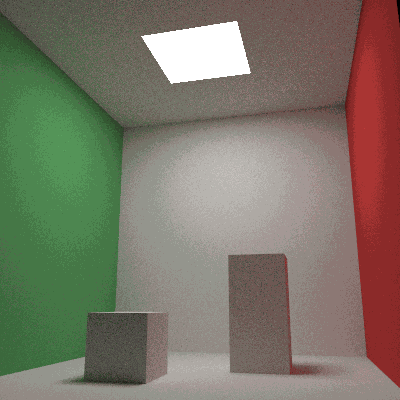
Captured Cornell scene, first test camera. This path-traced image is an observation from the raw camera array and the reference for the adjacent model outputs.
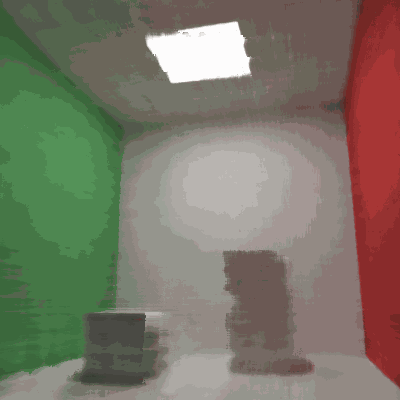
NeRF at the same test camera after a recorded 3,000-step run. Surface softness and residual noise remain visible.
Native ray-space walkthrough: move the inspection camera around the captured Cornell observations while the rig map, sample markers and matching controls stay visible. This recording shows direct image-based reconstruction, not a trained neural model.
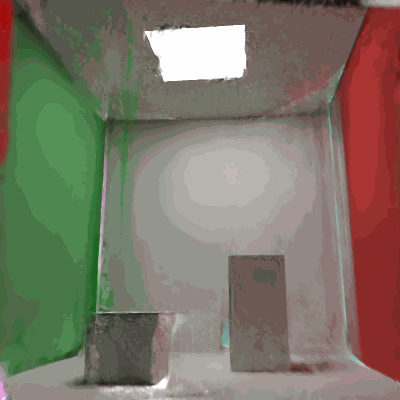
Gaussian splatting at the same test camera after a recorded 5,000-step reference-backend run. Different training budgets make this an artifact comparison, not a controlled method ranking.