A WebGPU renderer opened stage by stage, with a wider collection spanning pure mathematics, 3D cellular life, reaction–diffusion, swarm dynamics, forward and inverse physics, and quantum measurement models. Shaders, buffers and intermediate fields connect each result to the computation behind it.
Choose geometry layers or a complete-image renderer and its resources.
▧
Inspect the buffers
Connect intermediate images and working fields to the final display.
∇
Change the model
Probe traversal, pressure, material or optical assumptions in a focused lab.
Δ
Read the consequence
Compare numerical diagnostics with the image or measured distribution.
The attractive result has an inspectable model and data flow behind it.
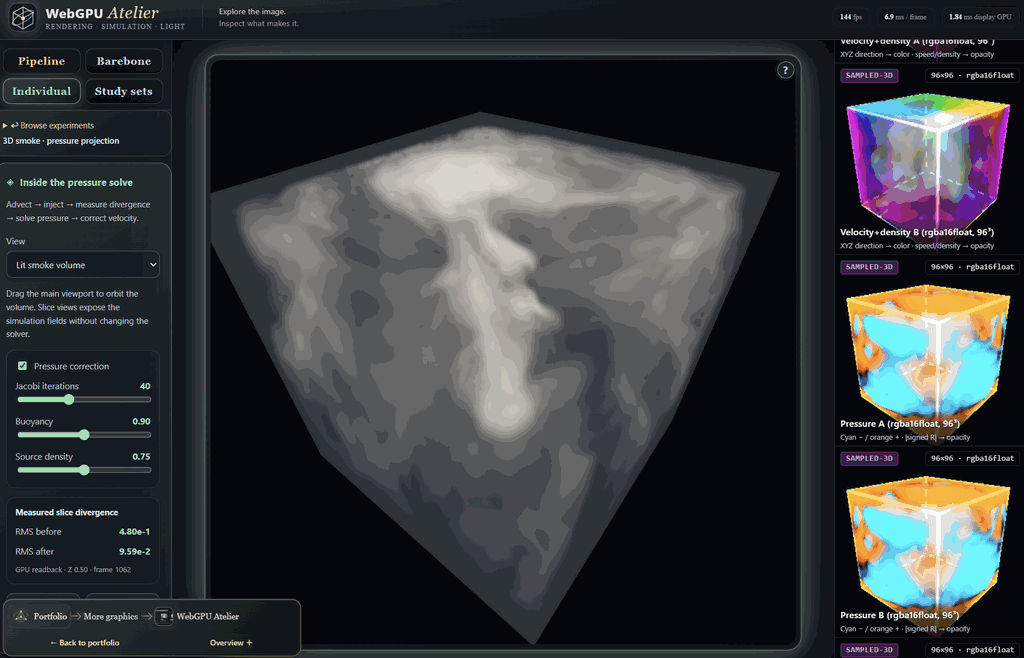
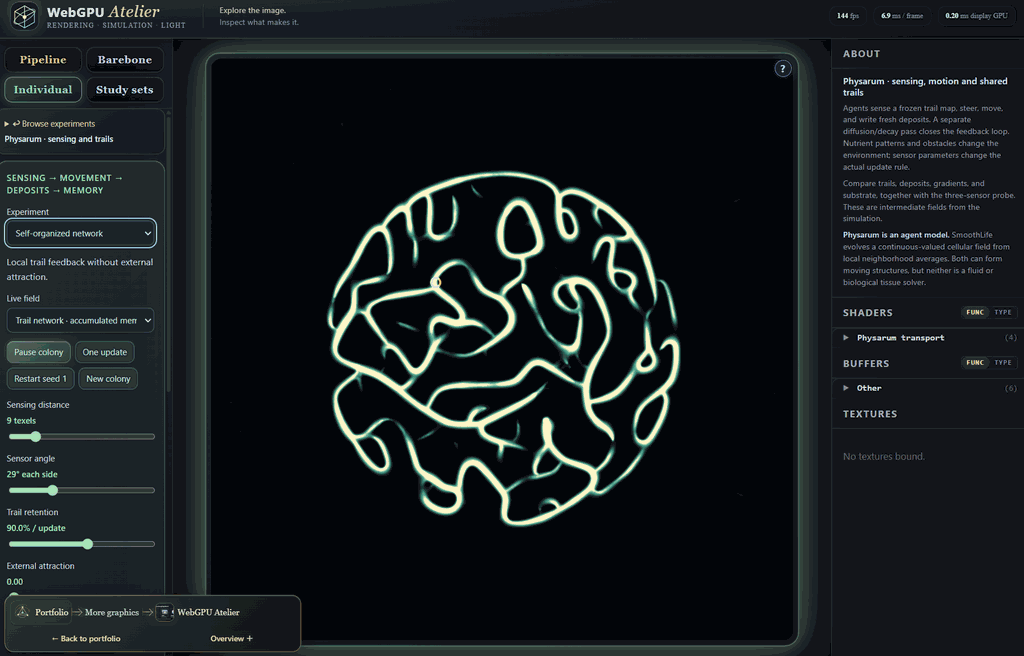
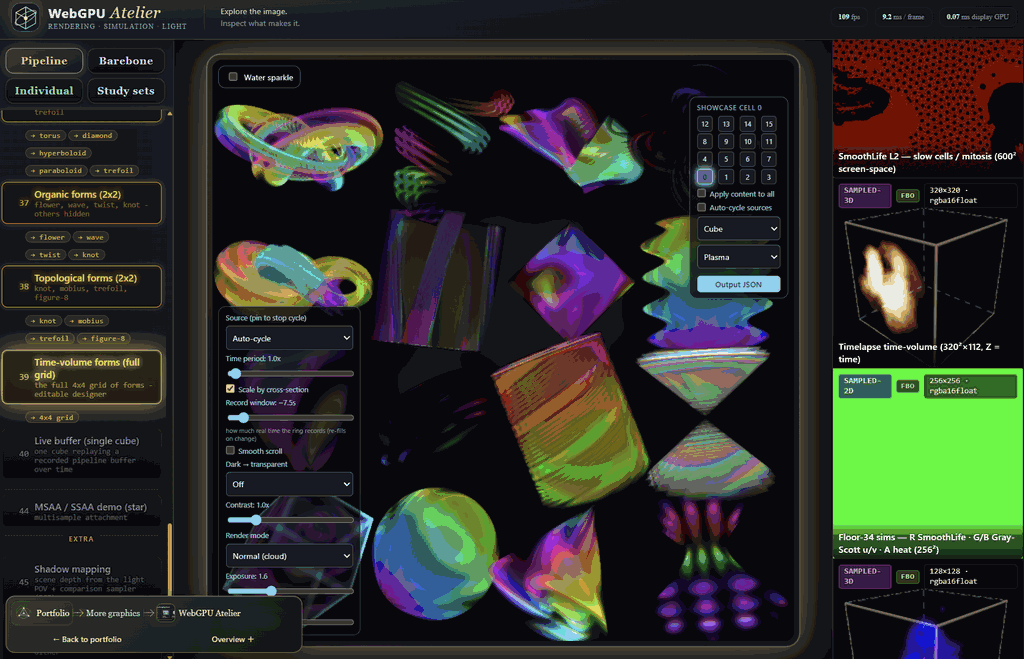
A lit smoke volume beside velocity, density and pressure buffers, with pressure-solve diagnostics.Mach–Zehnder wavepacket study: change the relative arm phase, compare the ideal two-port reference, and watch repeated packets reach the detector strips. Hue shows phase; brightness shows density. This model uses a matter-wave equation as an optical analogy, rather than simulating literal photons.Physarum trail network with sensing distance, sensor angle and trail-retention controls.Organic and topological forms in the time-volume gallery, with shape, source and display controls.