The integral stays visible
Direction transforms, polygon projection and boundary integration connect the rendered image to its computation.
Linearly Transformed Cosines approximate a complex BRDF lobe with a transformed cosine, turning direct lighting from polygonal area lights—especially quads—into closed-form edge integrals. Compare that deterministic result against Monte Carlo in a material garage while the fit and geometry stay inspectable.
Explore connections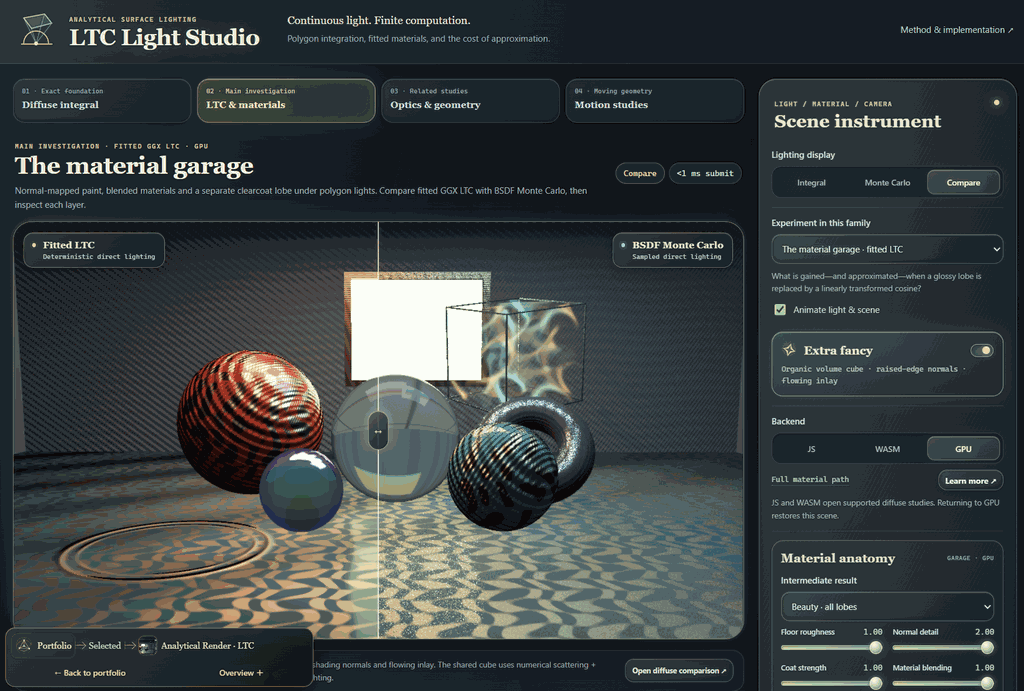
A distribution fitted in advance makes an expensive lighting question a compact geometric computation.
Approximate the GGX directional response by a linearly transformed cosine.
Express the polygon vertices in the fitted cosine distribution’s coordinates.
Accumulate oriented edge contributions over the transformed spherical polygon.
Place the fitted result beside Monte Carlo direct lighting and inspect approximation error.
Direction transforms, polygon projection and boundary integration connect the rendered image to its computation.
Procedural material blends, shading normals and an independent clearcoat lobe expose both the usefulness and limits of the fit.
A stable deterministic image and a sampled reference answer different questions: convergence removes sampling noise, but cannot remove a fit’s bias.
Soft area lighting normally integrates a response over many incident directions. For a uniform polygonal emitter, the projected solid angle gives an exact diffuse building block under the stated visibility assumptions. LTC extends that geometric route to a fitted glossy distribution.
The garage compares deterministic fitted GGX LTC and Monte Carlo direct lighting for the same opaque material model. It is not a full path-tracing comparison. The glass, thin-film and numerical medium terms are shared scene effects; the cube’s single scattering is not analytically integrated by LTC.
JS and WASM expose compatible diffuse studies. The garage’s fitted materials and additional scene effects use the WebGPU implementation, so changing the backend also selects a supported experiment.
 Recorded examples · 2Analytical and sampled direct lightingMaterial and emitter studies compare fitted LTC against Monte Carlo under the selected backend.+