Clique Proofs
An educational proof atlas, still growing: why do Prim and Kruskal both work, and why can compactness have such different definitions? Follow direct arguments between equivalent viewpoints and inspect the assumptions each route needs.
Explore connections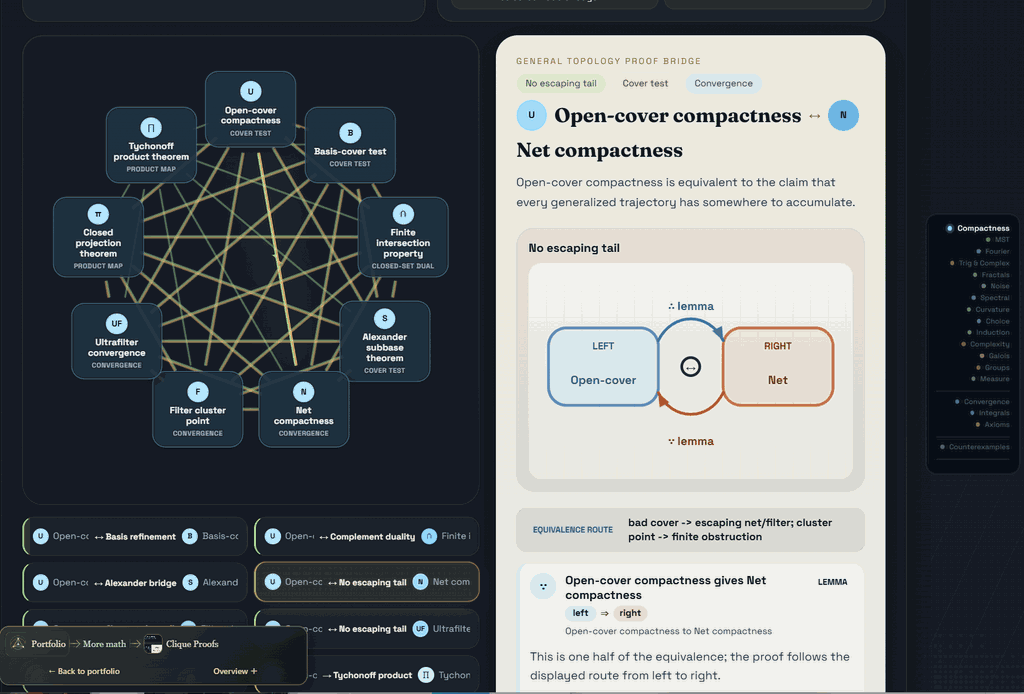
Open the application, then follow what changes
A growing educational atlas of direct proof routes. Compactness, minimum spanning trees and Fourier-related clusters connect apparently different formulations of one concept; each bridge exposes assumptions and structure that a bare equivalence statement can hide.
-
01
Choose a viewpoint
Start from a familiar formulation in a focused concept cluster.
-
02
Follow a proof
Read the direct argument connecting it to another formulation.
-
03
Compare the routes
Inspect what a different bridge reveals about the same structure.
-
04
Test the assumptions
Use counterexamples and scope notes to locate an equivalence's limits.
Write the direct argument, then compare the route
This is a work-in-progress learning atlas. The aim is to explain known connections through direct arguments and visual navigation; the novelty sought is in the exposition and choice of route, rather than a claim of new theorems.
The starting point is a familiar implementation question: two algorithms behave differently, yet both are correct. The next step is to inspect their shared invariants and the direct proof that connects those viewpoints. Compactness supplies a different setting for the same investigation: apparently unrelated definitions can characterize one property, but the assumptions and the route between them matter.
A textbook can establish equivalence with a short chain. Clique Proofs aims to fill the direct arguments between viewpoints: reaching C from A through B and proving A → C directly can expose different constructions, invariants or certificates. The extra edges carry the substance of the project.
The graph is a way into the argument. Select a statement or relation, inspect the proof and its assumptions, then compare another route through the same cluster. Density is useful when the selected edge remains readable and its reasoning can be examined.
Start with a focused cluster
The focused edition selects fourteen proof webs, three implication ladders and a counterexample collection. MST connects cuts, cycles and exchange arguments; the compactness cluster compares covers and other witnesses, with hypotheses stated on each relation; Fourier operators connect spatial and frequency viewpoints. For example, sequential compactness and compactness agree in metric spaces, but that equivalence cannot simply be asserted for every topological space.
The full archive retains wider subject roadmaps and cross-field bridges. Both editions share the same entry explanation, including a small diagram distinguishing a direct argument from a chain of implications.
Make the limits of an equivalence visible
One-way implications, scoped equivalences, open questions and counterexamples have distinct meanings. The assumptions on an edge matter as much as its endpoints; a visually dense graph is not evidence that every nearby concept is interchangeable.
Spectral, Fourier, geometric and algorithmic examples make the practice relevant to engineering: a different formulation may suggest a representation, a certificate of correctness or a more useful algorithm. The atlas demonstrates that habit through authored explanations.
 Recorded examples · 2Proofs as a connected structureImplications and proof bridges expose how the statements relate.+
More recorded views · 1
Current scope
- Work in progress: clusters and proof edges have different levels of detail. A visible relation is an invitation to inspect its proof and hypotheses, not a claim that the full archive is complete or formally verified.
- The atlas is authored mathematical exposition, not automated theorem proving. Relations and proof text are curated by hand.
- The aim of developing direct proof edges does not mean every possible edge in every topic has a completed direct proof. Open, one-way and conditional relationships retain their own labels.