Interactive application
Interactive
Overview · selected highlights

Computational photography

Treat photographs as measurements and change the representation before reconstructing them. Explore bilateral grids, geometric voting, robust stitching, calibrated HDR merging, gradient and frequency editing, and refocusing a rendered camera array using its images alone.

Several measurements; one photograph
CaptureAlignReconstruct
Brochure →Open project ↗
  1. ▧

    Collect the evidence

    Start with images, exposures, correspondences or calibrated camera-array views.

  2. F

    Change representation

    Lift pixels into grids, gradients, frequency coefficients or ray space.

  3. Σ

    Edit or combine

    Filter, solve, align or integrate the information in that representation.

  4. Δ

    Reconstruct and inspect

    Compare the output with residuals and intermediate data.

The intermediate representation explains what an image operation can preserve, reveal or lose.
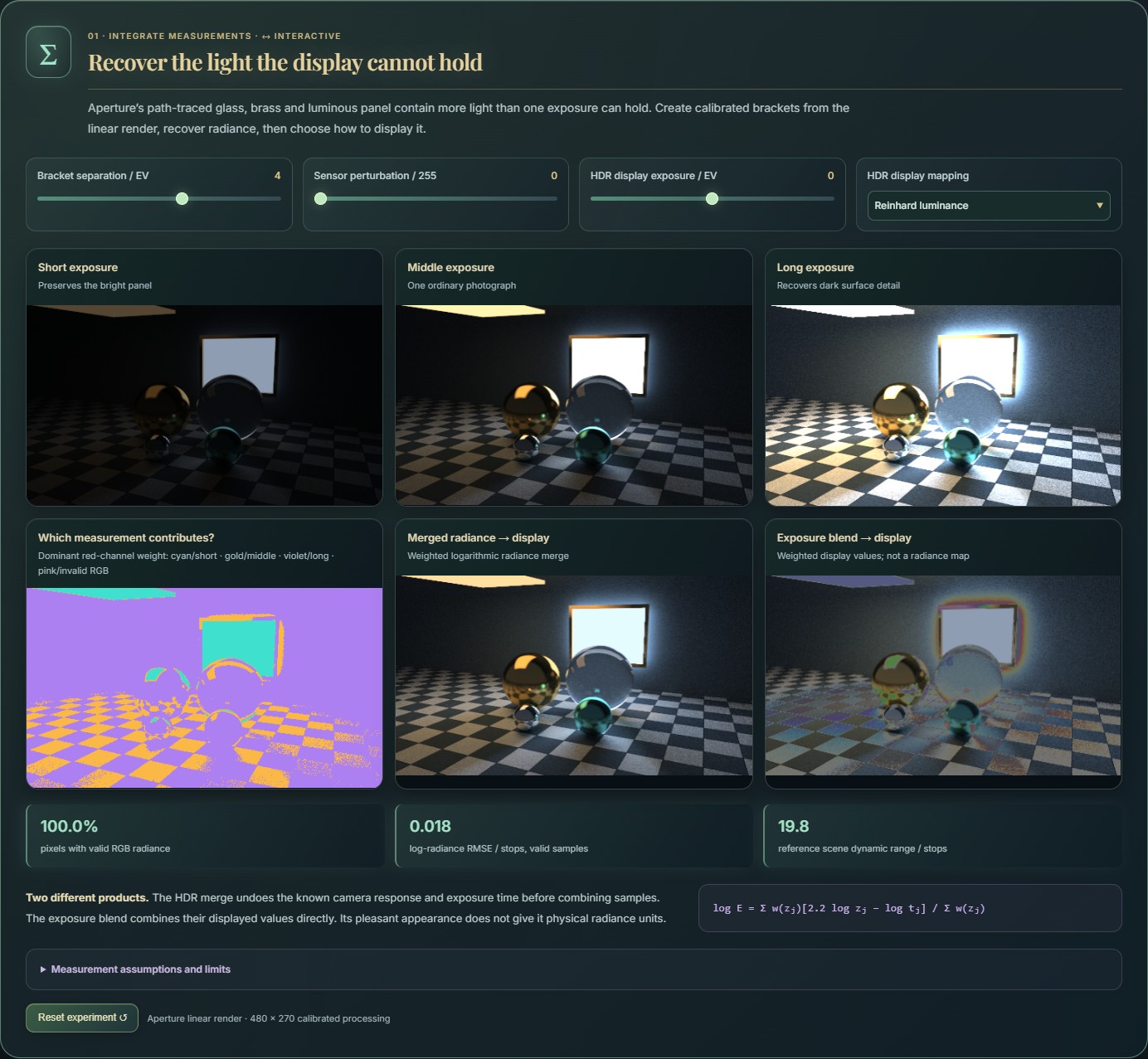
Current HDR workbench: three calibrated exposures from an Aperture render, contribution weights, recovered radiance and a display-value blend. This is a rendered teaching scene, not a camera photograph.
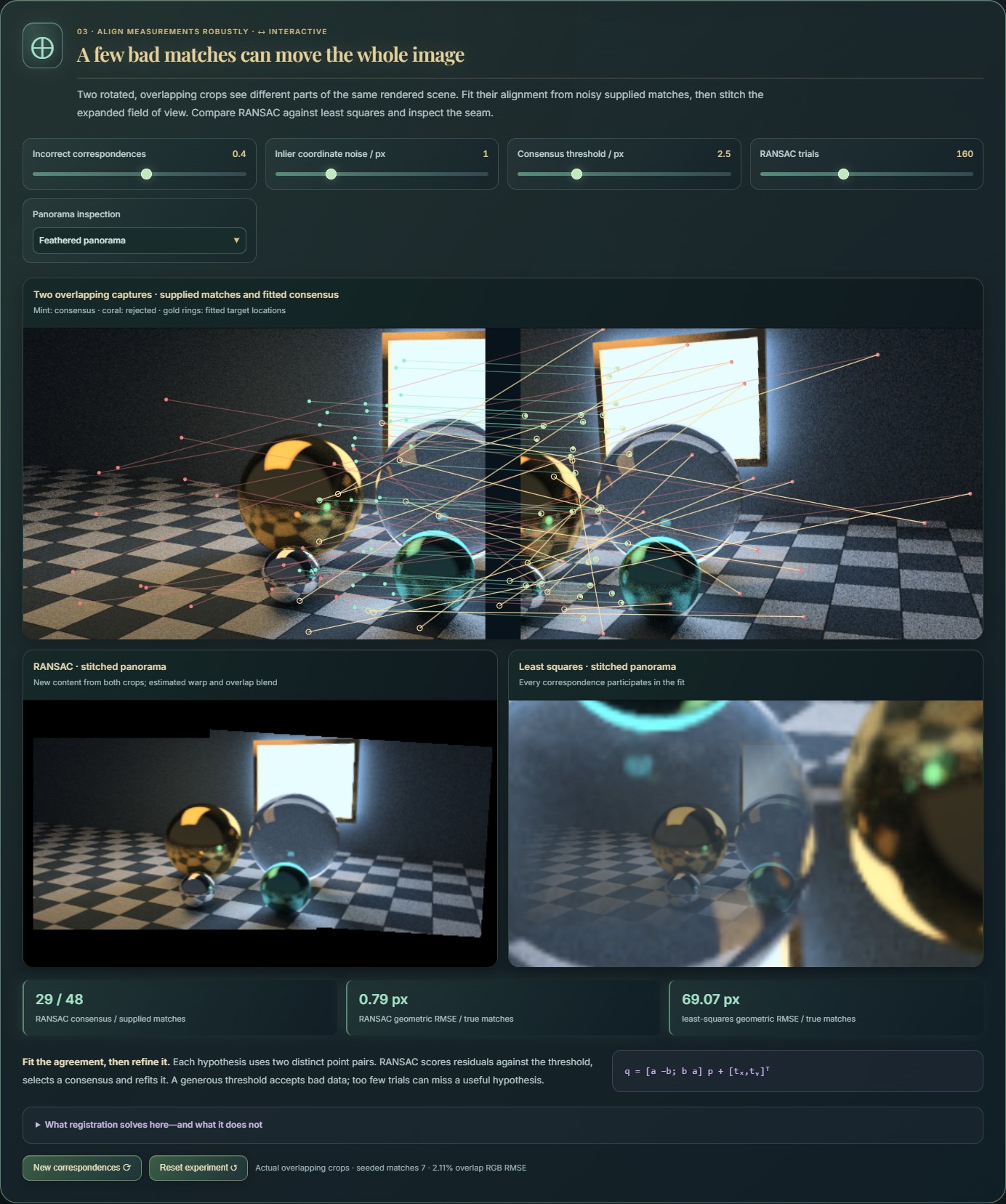
Controlled registration with 40% incorrect supplied correspondences: fitted consensus, RANSAC panorama and least-squares panorama. The matches are synthetic inputs; this demonstrates robust fitting, not feature detection.
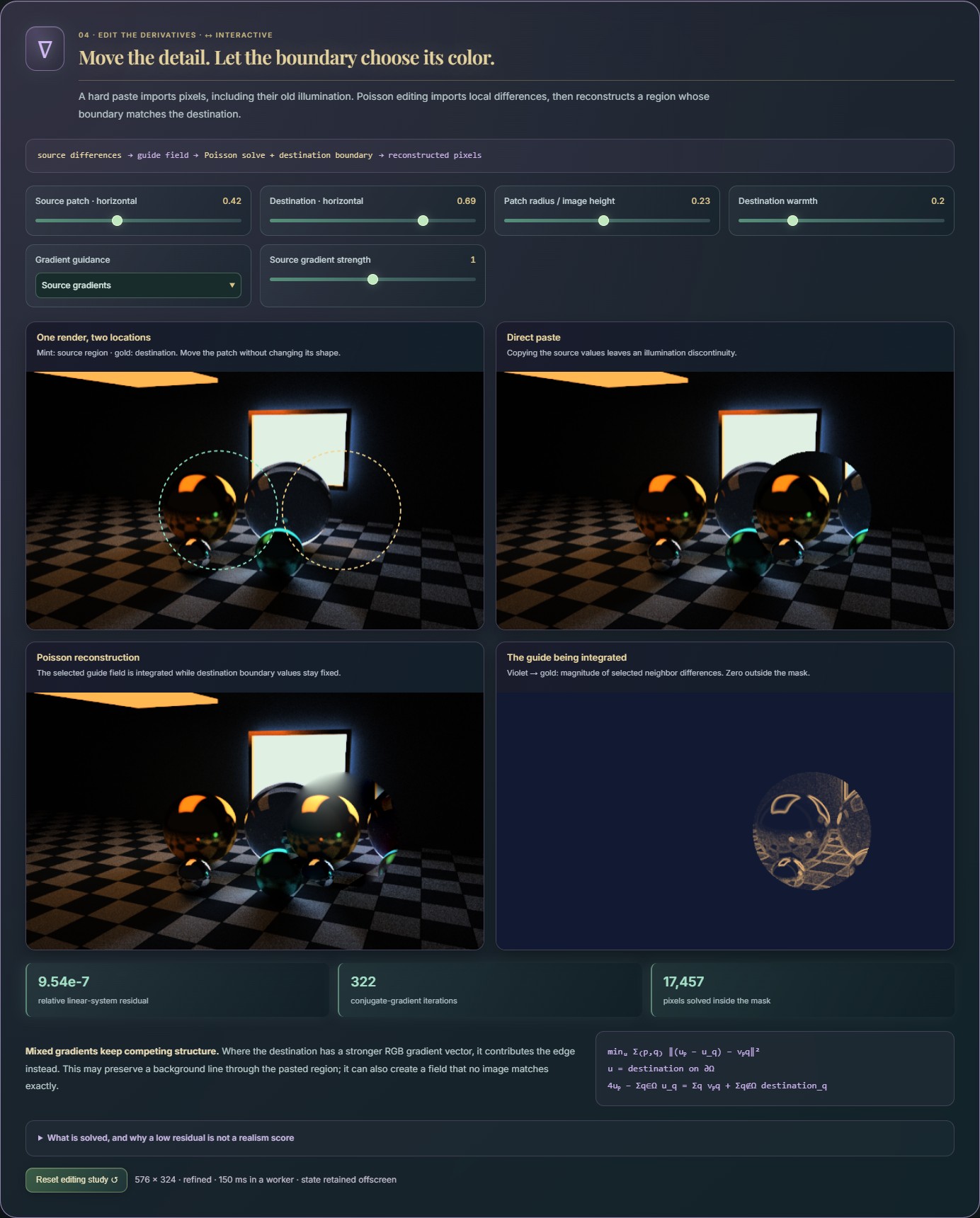
Gradient-domain editing: source and destination regions, direct paste, Poisson reconstruction and the guide field. Boundary matching changes the patch shading; a small solver residual does not certify a physically plausible composite.