Advanced Rubik & Variant Studio
Begin with Latch Cube, where each turn changes which turns are legal. Compare directional locks, bandaged pieces, coupled moves, and reactive variants through synchronized 3D puzzles, flat nets, and local route graphs.
Explore connections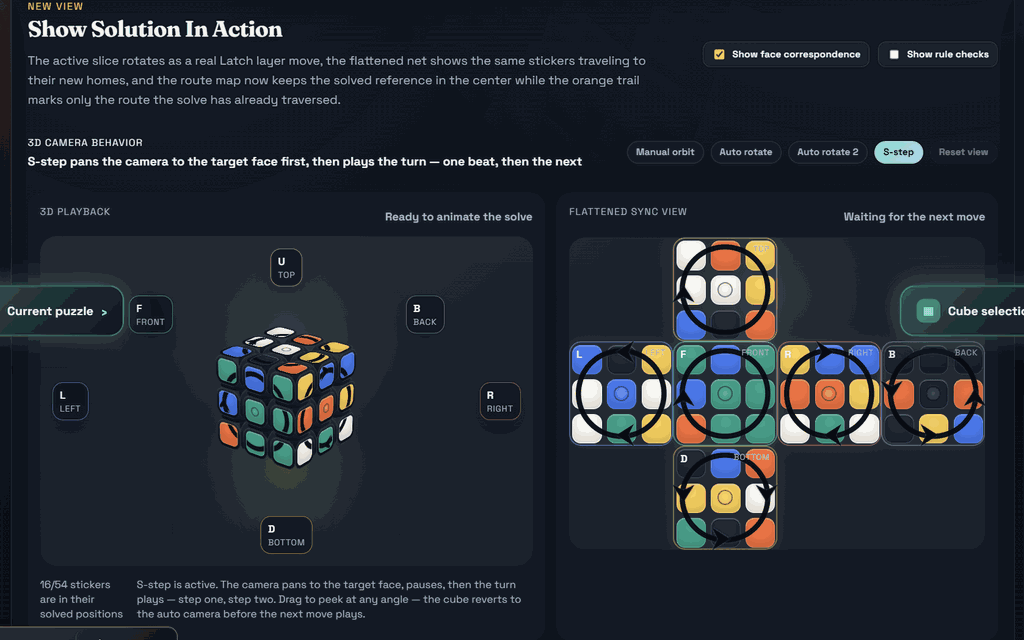
Open the application, then follow what changes
A puzzle studio where a move can change which moves are legal next. Begin with Latch Cube, then compare directional locks, bandages, coupled turns and reactive variants through synchronized 3D puzzles, flat nets and local route graphs.
-
01
Choose the mechanics
Select a variant with explicit move constraints and state changes.
-
02
Make a legal turn
Watch the move alter both the puzzle and future possibilities.
-
03
Inspect another view
Relate the 3D puzzle to its net and available routes.
-
04
Explore a route back
Use the supported solving tools to examine how the constraints matter.
One move, multiple synchronized explanations
The central experiment is the rule system. A familiar cube becomes a different algorithmic problem when a turn locks a direction, moves several parts together, or changes the rules for the next turn. Latch Cube is the default because that dependency is immediately visible.
A move sequence can be played forward or backward while a 3D puzzle and flat net remain synchronized. Highlights and arrows connect notation to piece motion, and milestone views keep the overall strategy visible.
The interface makes state transitions inspectable instead of presenting a raw solution string. A local graph provides a second way to examine the nearby search space.
Represent the mechanics of each puzzle family
The registry includes ordinary cubes alongside latch, bandaged, gear, slider, and reactive variants. Their move rules change legality or couple several state updates to one input.
A shared presentation can therefore show both familiar puzzles and unusual transition systems without pretending they have identical solving problems.
Unbreakable L is the three-cubie bandaged elbow: its pieces remain fused, so moving the block changes which face turns are legal. The descriptive name identifies the constraint directly; it is a studio preset rather than a claim to reproduce a commercial puzzle.
Make the route home explicit
Pocket Cube uses a state-search solve path, and ordinary 3×3 inputs can use a dedicated solver. Latch variants work backward through recorded scramble states, using bounded searches of legal turns on the relevant face before shortening same-face runs. The returned route is checked against the rules.
A legal route for a recorded scramble is a useful guarantee; it does not establish a globally shortest path or completeness for arbitrary states. Other variants use their own search, guide, reversal, or fallback, identified in the interface.
 Recorded examples · 3Puzzle rules and solution structureAlternate rules, synchronized views and route maps expose the state space.+
More recorded views · 1
Current scope
- Many variants use inverse scramble playback rather than a general solver.
- Some moving-center or marker-drift fallbacks can finish short of a perfectly solved state.
- The local state graph is a bounded neighborhood, not an exhaustive graph of the puzzle's full state space.