Laplace transform studies
Explore how the Laplace transform extends Fourier analysis with exponential weighting. Drag a slice through complex frequency, inspect convergence and reconstruct a signal from a contour. See how convolution in time becomes multiplication after transformation.
Explore connections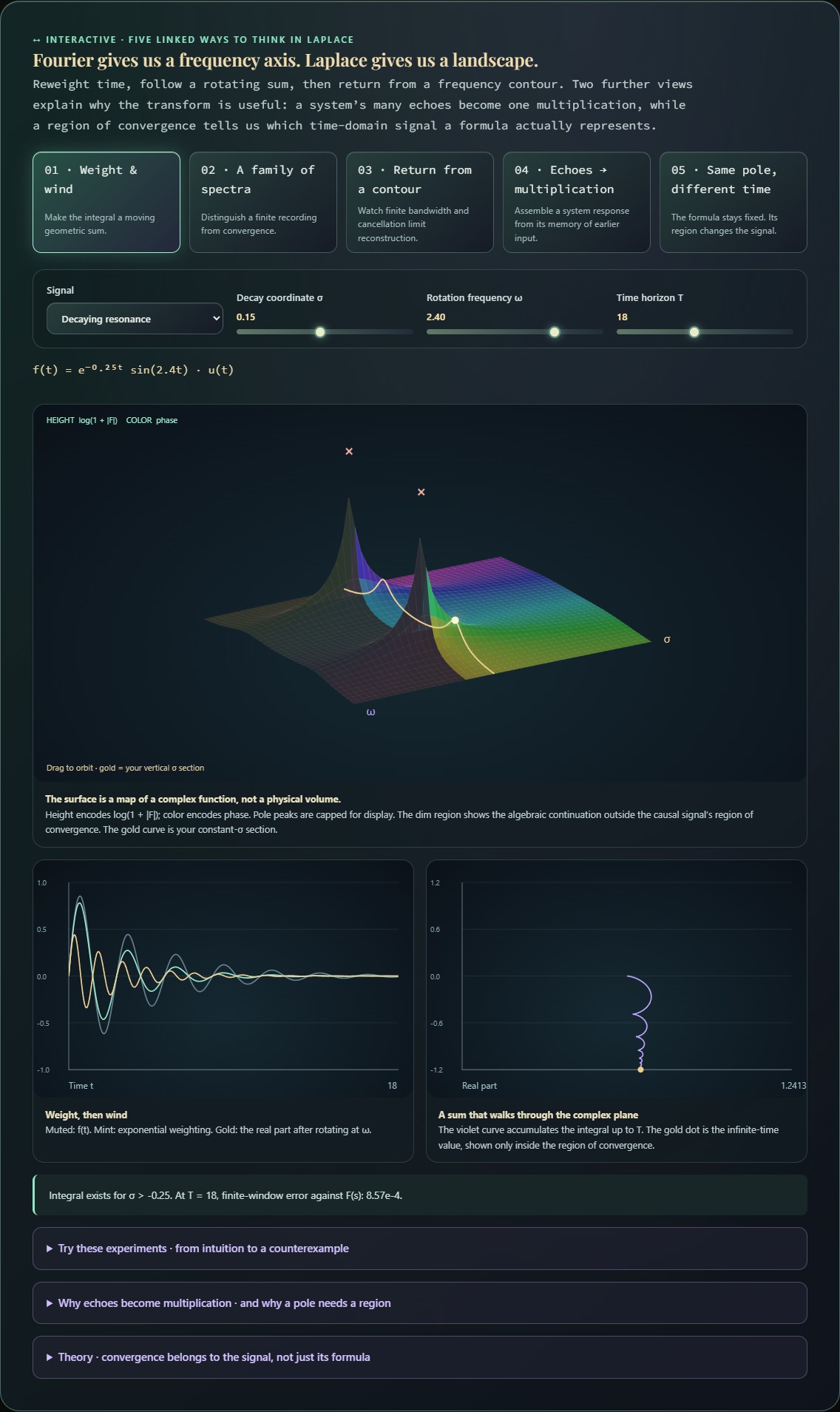
Four ways into the same transform
Start with Echo studio, the main visual exploration. The other instruments connect its geometry to familiar transform operations. Each has its own function selection and controls; use the launch links above to enter directly.
-
01
Echo studio
Choose an input signal and change memory decay. Each ribbon is one delayed, fading contribution; their sum forms the response. Orbit the scene and inspect an individual echo.
-
02
Memory sculpture
Choose a kernel, then change frequency and decay. Turns and envelope become a glowing field through time. Orbit to inspect this geometric companion to the echo sum.
-
03
Three linked studies
Switch between exponential weighting, the transform landscape and contour inversion. Drag the complex-frequency probe or the slice; compare the signal, winding and transform together.
-
04
Same poles. Different time.
Choose a rational transform, then switch the supported half of time. Watch the time signal and convergence region change together: a formula alone does not identify the bilateral signal.